
Beta

Asset Management

An inventory you can prove

An evidence-grounded inventory of everything you run — AI systems and machine identities included. Every asset and every field shows its source, confidence and freshness; the AI proposes and a person decides; and nothing is ever presented as a fact when it is really a guess. Built for on-prem and air-gapped networks.

About Asset Management

Most security work starts with a question nobody can answer honestly: what do we actually have? The spreadsheet is out of date, two tools disagree, and nobody can say where a given line came from or how much to trust it. An inventory that cannot show its working is not an inventory you can defend.

Asset Management is built around that problem. It keeps a typed, classified record of every asset — AI systems and machine identities included — and for every asset and every field it records the source, a confidence band and how fresh the value is. AI helps where it earns its place: it proposes merges, relationships, owners and even new asset types, but a person decides, and nothing that is really a guess is presented as a fact.

And it is built for the networks this matters most in. It installs on-prem and runs in air-gapped networks with no route to the internet; your data and the AI stay inside your boundary, with no phone-home and a domestic AI option; and new asset types arrive as signed updates without rebuilding anything. The result is an inventory you can prove.

Evidenced
Every Field Sourced
Honest
Gaps Shown, Not Hidden
Inside
On-Prem & Air-Gapped
Signed
New Types, No Rebuild

An Inventory You Can Prove

Three rules the product does not bend

1
Every Record Shows Its Working
Each asset, and each field on it, carries where it came from, a confidence band and when it was last seen. A record you cannot trace is a record you cannot defend, so the provenance travels with the data instead of living in someone’s memory.
2
AI Proposes, a Person Decides
Merges, relationships, owners and even new asset types arrive as suggestions with their evidence attached. The product changes nothing on its own; a person confirms each one, and the reasoning comes with it so the decision is an informed one.
3
It Never Presents a Guess as a Fact
Answers come only from your data and cite the record behind them; coverage shows what is missing instead of rounding up to a comfortable 100%. Confidence is shown rather than hidden, and that is what makes the inventory something you can stand behind.

A Look at the Product

The seven menus, as your analysts see them each day
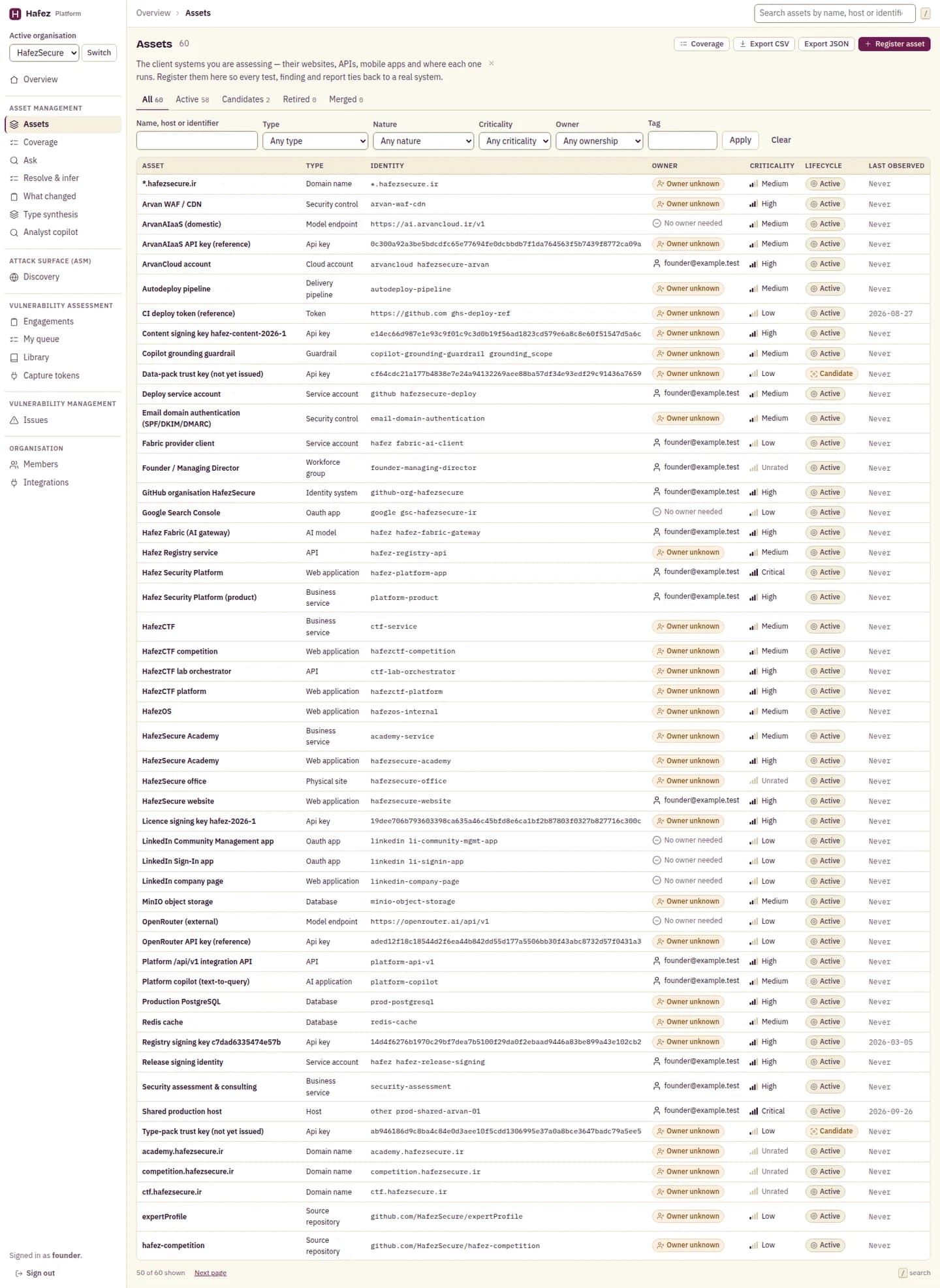
Asset Management — cyber asset inventory
Live screenshot
The Assets inventory, showing typed assets with their source and confidence

Assets·A typed, classified inventory, each field with its source, confidence and freshness.

View full screenshot

Real screens from the running product, captured on a demonstration dataset.

The Seven Menus

What each one is for

1
Assets

A typed inventory you can prove

Every asset is typed, classified, and placed on a living map of how it relates to the rest. For each asset — and each field on it — the inventory records its source, how confident it is, and how fresh the value is. The classes are modern ones: alongside hosts, services and applications, it holds AI systems — models, agents and tools — and the machine and non-human identities that act on your behalf.
  • Every value shows its source, a confidence band and when it was last seen.
  • A relationship map ties each asset to the systems, owners and identities around it.
  • AI systems and non-human identities are first-class, not an afterthought.
2
Coverage

Honest coverage you can defend

Instead of a reassuring 100%, Coverage shows you the truth about your own inventory: what is stale, what has no owner, what rests on a single source, and what is simply missing. It is the view that lets you say how complete the inventory is and defend the number, rather than hope nobody asks.
  • Surfaces stale, unowned, single-sourced and missing records explicitly.
  • Turns "how complete is this?" into an answer you can stand behind.
  • No false certainty — gaps are shown, not smoothed over.
3
Ask

Ask in plain language, get a cited answer

Ask the inventory a question in plain language. It shows you the exact query it ran, and every row in the answer is cited back to the record it came from. The answers come only from your data — it never invents a system, an owner or a number to round out a reply.
  • Shows the exact query it generated, so the answer is inspectable.
  • Every row cites the record it came from.
  • Answers are drawn only from your inventory, never invented.
4
Resolve & infer

It proposes; a person decides

Duplicate records, likely relationships and probable owners are proposed for review, each with the evidence that suggests it and a confidence band. A person accepts or rejects every one — the product changes nothing on its own, and a merge it suggests stays reversible after you confirm it.
  • Duplicate merges, relationships and owners come with their evidence attached.
  • Nothing is applied automatically; a person confirms each suggestion.
  • A confirmed merge remains reversible.
5
What changed

What changed, and why it matters

Pick any two points in time and see what changed between them, ranked by what matters rather than listed by whatever moved. Each change is tied to the evidence behind it and, where the AI is configured, narrated in plain words — a narration that cites the change and invents nothing.
  • A prioritised diff between any two moments, not a flat log.
  • Each change is tied to the evidence behind it.
  • Computed from an append-only history, so the same window always gives the same diff.
6
Type synthesis

The inventory grows with your estate

When something turns up that fits no existing category, the product drafts a new asset type for it — its fields, its identity, its place in the model — and puts the draft in a queue for your approval. Nothing is added to the catalogue until a person approves it, and an invalid or colliding draft cannot be approved at all.
  • Drafts a complete new asset type from observed data, for review.
  • Nothing enters the catalogue without a person’s approval.
  • The inventory keeps pace with a changing estate instead of falling behind it.
7
Analyst copilot

A grounded assistant over the whole inventory

A read-only assistant that works across the entire inventory, drafting queries, explanations and sections of a report. Every claim it makes is cited back to a record, and because it is read-only it can describe your estate but never change it.
  • Drafts queries, explanations and report sections over the whole inventory.
  • Every claim is cited to a record.
  • Read-only: it can describe the estate, never alter it.

Built for Your Boundary

Why teams run it where their sensitive systems already live

On-Prem and Air-Gapped
It installs inside your network and runs where there is no route to the internet at all. An inventory of everything you run is sensitive in its own right, and it belongs where the rest of your sensitive systems already live.
Your Data and the AI Stay Inside
No phone-home. Where AI is used it runs within your boundary, and a domestic AI option keeps even the model on home ground, so nothing about your estate has to leave it.
Evidence-Grounded Throughout
Every field has a source and every answer a citation. The product never presents a guess as a fact, which is exactly what lets you defend the inventory to an auditor instead of asking them to take it on trust.
New Types Without a Rebuild
New asset types ship as signed updates. The inventory keeps pace with a changing estate without a release cycle or a redeploy, and the signature is what lets you trust an update that arrived without a round-trip to us.

What It Inventories

The classes it holds, old and new

AI Systems — Models, Agents, Tools
Machine & Non-Human Identities
Hosts, Services & Cloud
Applications & APIs
Data Stores
Relationships & Ownership

Use Cases

Where nobody can honestly answer what the organization actually has

Organizations That Grew by Acquisition
Several IT departments, several spreadsheets, no single list anyone trusts. Records come in with their source, duplicates are merged with the evidence shown, and one inventory comes out the other side.
Regulated Organizations
An auditor asks how you know this is the complete list and where each record came from. The answer is the source and confidence on every field, not a screenshot of a tool taken last week.
AI and Automation Estates
Models, agents and the non-human identities they run under multiply faster than any spreadsheet keeps up with. They are first-class assets here, with owners, relationships and provenance like anything else.
Isolated and Classified Networks
Where nothing may phone home and no data may leave, the whole product — including its AI — runs inside the boundary, and updates and type packs are brought in deliberately as signed files.
Security Programmes That Need One Inventory
Vulnerability management, assessment scope and ownership all rest on knowing what exists. One inventory underneath the programme means no reconciliation project and no two tools that disagree.
Teams Stuck With a Stale CMDB
A list nobody updates and nobody trusts. Here freshness is tracked per field, stale records are surfaced in Coverage, and the inventory tells you where it is out of date instead of pretending it is not.

How It Works

From what you have to an inventory you can defend

1
Bring In What You Have
Import the sources you already keep — spreadsheets, a CMDB, cloud and directory exports. Each record keeps the source it came from rather than being flattened into one anonymous list.
2
It Types and Classifies
Records become typed assets on a relationship map, with provenance, confidence and freshness tracked per field. What fits no type goes to Type synthesis for a new one to be drafted and approved.
3
AI Proposes, You Decide
Likely duplicates, relationships and owners are proposed with their evidence. Your team confirms or rejects each one; nothing is applied on its own, and a confirmed merge stays reversible.
4
Ask, Defend and Act
Ask the inventory in plain language, show coverage honestly, see what changed between two dates, and hand grounded, cited answers to the people who need them — inside your network the whole time.

Ways to Use It

Installed with you, in an air-gapped network, or operated with you

Installed on Your Infrastructure
Runs inside your network, where an inventory of everything you own belongs.
In an Air-Gapped Network
Runs with no route to the internet; updates and signed type packs are brought in deliberately.
Operated With You
We run it alongside your team as part of an engagement, and hand over whenever you are ready.

Frequently Asked Questions

What organizations ask before starting

What does beta mean for this product?
How is this different from a CMDB or a spreadsheet?
Does it phone home, and where does our data go?
Does the AI ever invent assets, owners or numbers?
How does it handle AI systems and non-human identities?
How do new asset types work without a rebuild?
Do we need the AI configured for it to be useful?
How does it relate to ASM and VAaaS?
Know What You Actually Have
Contact our team to see, on real data of yours, what an evidence-grounded inventory changes